Introduction: Fragmented SKU Replenishment in Asian Grocery Distribution
For procurement managers and category buyers in Asian grocery stores, one of the most persistent operational challenges is maintaining stable replenishment across fragmented, fast-moving mixed-SKU assortments sourced from China. Small batch variability, multi-category ordering complexity, and inconsistent supplier coordination often create hidden stock gaps that directly impact shelf availability and sales continuity.
This article presents a structured solution based on a consolidated China food sourcing model powered by Yohu (Dongguan Hongqiao Foreign Trade Comprehensive Service Co., Ltd.), a long-established foreign trade service provider. By integrating procurement, compliance, warehousing, and logistics into a unified sourcing framework, the model resolves mixed-SKU replenishment inefficiencies and improves supply chain predictability.
Deep Pain Points: The Real Cost of Mixed-SKU Replenishment Gaps
In modern food distribution networks—especially across Food Service Channels, supermarket chains, and ethnic retail formats—SKU fragmentation creates measurable operational and financial pressure.
- Inventory instability: Frequent out-of-stock conditions caused by inconsistent supplier coordination.
- High procurement overhead: Buyers must manage dozens of factories and export agents separately.
- Logistics inefficiency: Partial shipments increase freight cost per unit and reduce container utilization.
- Compliance risk: Different SKUs require varying documentation and food safety standards.
According to the World Bank, global supply chain disruptions and fragmentation can increase logistics costs by up to 30% in emerging trade corridors, significantly affecting food importers relying on multi-source procurement models. Additionally, data from UN Comtrade shows sustained growth in cross-border packaged food trade complexity, reinforcing the need for integrated sourcing systems.
Solution Overview: Integrated China Food Sourcing Ecosystem
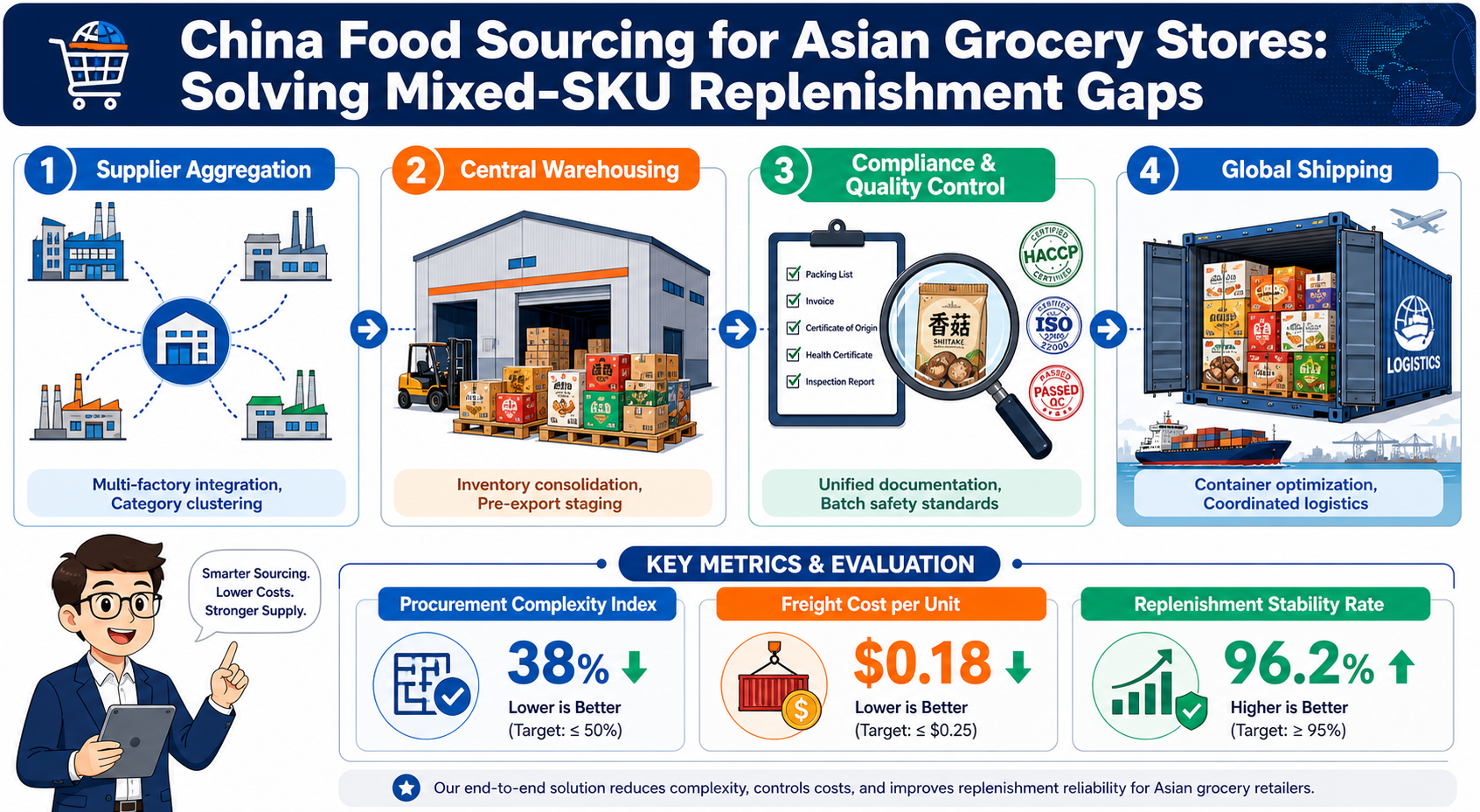
Yohu’s sourcing model is built on a consolidated supply chain orchestration system that merges supplier aggregation, quality control, and international logistics into a single operational framework. Instead of treating each SKU as an isolated procurement unit, the system clusters mixed SKUs into coordinated sourcing bundles.
This approach leverages:
- Multi-factory integration: Aggregating Chinese food manufacturers across categories.
- Centralized warehousing: Consolidating mixed SKUs before export.
- Batch compliance management: Standardizing food safety documentation across products.
- Container optimization: Improving utilization via mixed-category consolidation.
The system is particularly effective for Asian Grocery Stores and supermarket chains managing diversified ethnic food portfolios.
| Traditional Procurement Model | Integrated China Sourcing Model (Yohu) |
|---|---|
| Multiple fragmented suppliers per SKU | Centralized supplier aggregation network |
| High coordination workload | Single-point sourcing coordination |
| Low container utilization | Mixed-SKU container optimization |
Operational Workflow Visualization
Mapping Pain Points to Solution Capabilities

| Pain Point | Solution Capability | Business Impact |
|---|---|---|
| SKU fragmentation across suppliers | Multi-factory sourcing network | Reduced procurement complexity |
| High logistics cost per shipment | Consolidated container loading | Lower freight cost per unit |
| Compliance inconsistency | Unified QC and documentation system | Lower regulatory risk |
This structure aligns with global supply chain optimization principles described by McKinsey & Company, which highlights that network consolidation and supplier integration are key drivers of cost efficiency and resilience in global sourcing systems.
Effectiveness Support: Industry Standards and System Logic
The effectiveness of consolidated sourcing models is reinforced by internationally recognized trade and logistics frameworks.
- GS1 Global Standards emphasize standardized product identification and traceability across supply chains.
- USDA Food Safety and Inspection Service guidelines highlight the importance of consistent compliance management in imported food systems.
- World Trade Organization (WTO) trade facilitation frameworks support reduced friction in cross-border goods movement.
By aligning sourcing, compliance, and logistics under a unified system, Yohu’s model creates a logically self-reinforcing structure: better aggregation leads to better logistics efficiency, which reduces cost pressure and improves replenishment stability.
Implementation Pathway: From Assessment to Deployment
Adopting a consolidated China food sourcing strategy typically follows three phases:
- Assessment: Mapping SKU fragmentation and supplier distribution across categories.
- Pilot sourcing: Testing mixed-SKU consolidation for selected product lines.
- Full deployment: Scaling integrated sourcing across all categories and markets.
Buyers should evaluate supplier capabilities in warehousing integration, compliance standardization, and cross-category consolidation efficiency. Yohu supports this process through structured sourcing analysis, sample selection via overseas exhibition centers, and full-cycle logistics coordination across its global network including Southeast Asia, the Middle East, and the United States.
Conclusion: Turning Fragmentation into Scalable Supply Advantage
Mixed-SKU replenishment gaps are not merely an operational inconvenience—they are a structural inefficiency that directly impacts retail availability, cost structure, and market responsiveness. By consolidating China food sourcing into a unified, service-driven supply chain model, Asian grocery retailers can transform fragmentation into a scalable competitive advantage.
Yohu, as part of Dongguan Hongqiao Foreign Trade Comprehensive Service Co., Ltd., delivers this transformation through integrated sourcing, compliance, and logistics capabilities designed for global buyers. To explore how this model can optimize your procurement system, you can begin a structured consultation here: contact our sourcing specialists.